Mental Health: The Foundation of Everyday Life
Mental Health Is Not What You Think It Is: The Foundation Beneath Everything
When we hear the term “mental health,” our minds often jump to extreme scenarios: severe depression, manic episodes, psychotic breaks, or someone being hospitalized. Alternatively, in the age of social media, we might picture cozy aesthetic videos — a person sipping herbal tea, writing in a leather-bound journal, or taking a bath with candles.
While both images touch on parts of the story, neither captures the full truth. The reality of mental health is far more nuanced, far more ordinary, and far more universal than either of these extremes.
So, What Is Mental Health Actually About?
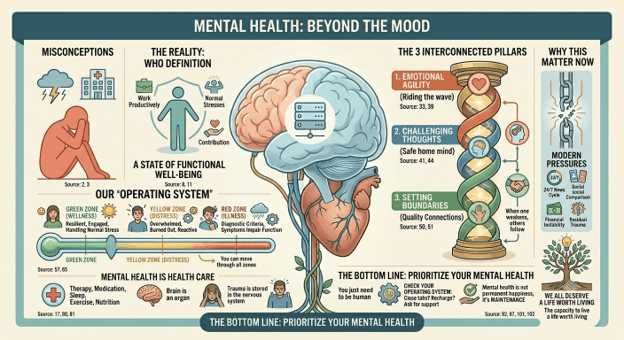
The World Health Organization provides a definition that is worth reading more than once. It states that mental health is “a state of well-being in which an individual realizes their own abilities, can cope with the normal stresses of life, can work productively, and is able to make a contribution to their community.”
Let us pause on those words: normal stresses, work productively, contribution. Notice what is missing. There is no mention of permanent happiness, constant confidence, or the absence of sadness.
The definition is not about floating through life on a cloud. It is about function, resilience, and connection.
The Silent Engine of Daily Life
To understand mental health practically, imagine it as the operating system running beneath everything you do. When a computer’s operating system works well, you do not think about it. You click, you type, you open files, and everything just works. But when that system becomes corrupted, every single task becomes slow, glitchy, or impossible.
The same is true for your mind. Your mental health is the software that manages your emotions, your thoughts, your behaviors, and your interactions with other people. When it is healthy, you hardly notice it. When it is struggling, you notice nothing else.
What does good mental health actually allow you to do on a Tuesday afternoon? It allows you to feel a full range of human emotions — sadness, anger, joy, fear, boredom, excitement — without being destroyed by any single one of them. It allows you to rebound from a fight with your partner or a critique from your boss without spiraling into shame or rage. It allows you to get out of bed, brush your teeth, and eat something, even on days when you do not feel like it. It allows you to connect with another person, to be vulnerable enough to say “I need help” or “I am sorry.” And it allows you to adapt when life throws a curveball — a layoff, a death, a move, a diagnosis — without falling apart completely.
When that engine sputters, everything becomes harder. Brushing your teeth feels like climbing a mountain in boots made of concrete. A minor text message left on read feels like a personal annihilation. The volume on life is either turned up too high, leaving you raw and overwhelmed, or turned off completely, leaving you numb and disconnected. That is what mental health struggles feel like: not sadness, but heaviness. Not worry, but paralysis.
The Three Pillars: Thinking, Feeling, and Acting
To make mental health less abstract, it helps to break it down into three interconnected domains. These pillars work together constantly, and when one weakens, the others usually follow.
Emotional
The ability to identify, tolerate, and ride the wave of your emotions without drowning or escaping.
Psychological
Self-esteem, problem-solving, and your ability to challenge distorted thoughts and hold realistic standards.
Social
The quality of your relationships, your ability to set boundaries, ask for help, and be truly honest.
Emotional Health (Feeling)
This pillar is not about being happy. It is about what psychologists call emotional agility. Can you identify what you are feeling right now, without immediately running from it? Can you tolerate discomfort — boredom, loneliness, frustration — without numbing it with a screen, food, alcohol, or endless scrolling? Emotionally healthy people absolutely experience anger and sadness. They cry. They get frustrated. The difference is that they do not let those emotions drive the bus indefinitely. They feel the feeling, they ask what it is telling them, and they let it pass. Emotional health is the ability to ride the wave rather than drowning in it or jumping off the board entirely.
Psychological Health (Thinking)
This pillar involves your self-esteem, your problem-solving skills, and your perception of reality. Do you hold yourself to realistic standards, or do you demand perfection? Can you challenge a negative thought like “I always mess everything up,” or do you accept it as a fact carved in stone? This pillar determines whether your mind feels like a safe home or a prison cell. When psychological health is strong, you can look at a mistake and say, “That was a bad choice, but I am not a bad person.” When it is weak, one error confirms your worst belief about yourself: that you are fundamentally broken.
Social Health (Connecting)
Humans are wired for connection. Our brains did not evolve to survive alone on a mountaintop; they evolved in tribes, villages, and families. Social mental health is about the quality of your relationships. Can you set a boundary without feeling guilty? Can you ask for help without feeling like a burden? Do you have at least one or two people with whom you can be truly honest? Loneliness is not just an unpleasant emotion; it is a significant risk factor for deteriorating mental health, as damaging as smoking or obesity. Social health is your lifeline to the rest of humanity.
These three pillars do not exist separately. When your thinking is distorted, your emotions spiral. When you are lonely, your self-esteem drops. When you cannot feel sadness, your relationships become shallow. Mental health is the dance between all three.
The Fluidity Factor: It Is Not a Binary Switch
One of the most liberating truths about mental health is that it is a continuum, not a light switch. You are not either “mentally ill” or “mentally well,” with no room in between. Imagine a thermometer with three zones:
Green Zone
You are resilient, engaged, sleeping reasonably well, handling normal stress, laughing genuinely, and recovering from setbacks in hours or days rather than weeks.
Yellow Zone
You are overwhelmed, burned out, grieving, or highly reactive. You are coping, but barely. Your operating system is lagging. You might still go to work and smile, but inside you are running on fumes.
Red Zone
Clinical depression, generalized anxiety disorder, bipolar disorder, or other conditions that meet diagnostic criteria. Symptoms are severe enough to impair daily function for weeks or months. You cannot just “snap out of it.”
You can move through all three zones in a single month, or even a single week. A death in the family pushes you from green into yellow. A promotion and a good vacation bring you back to green. A genetic predisposition for depression, triggered by a major loss, might tip you into red. This fluidity is not a weakness; it is simply the nature of being alive. And it means that mental health requires maintenance — just as brushing your teeth prevents cavities and changing your oil prevents engine failure, managing your stress and emotions prevents breakdowns.
The Great Misconception: It Is Not “All in Your Head”
We use the phrase “mental health,” which unfortunately makes many people believe that mental struggles are purely psychological, purely a matter of willpower or attitude. This could not be further from the truth. Mental health is profoundly, inescapably physical.
Neurotransmitters like serotonin and dopamine are chemical molecules. When they are out of balance, your thoughts are not the cause; they are the symptom. Chronic anxiety floods your body with cortisol, a stress hormone that damages your immune system, raises your blood pressure, and increases your risk of heart disease. Depression shows up not as sadness but as crushing fatigue, unexplained body aches, digestive issues, and changes in appetite.
Trauma is not just a memory; it is stored directly in your nervous system, in the tension of your shoulders, the clenching of your jaw, the hypervigilance that keeps you scanning every room for danger.
You cannot “positive think” your way out of a chemical imbalance, any more than you can think your way out of a broken leg. You cannot ignore the physical reality of trauma and expect it to vanish. Mental health care — therapy, medication, sleep, exercise, nutrition — is health care, period. The brain is an organ, just like the heart or the liver. When it is sick, it deserves treatment, not shame.
Why This Matters Right Now
We are living through a global epidemic of burnout, anxiety, and loneliness. The pace of modern life has stressed the operating system of millions of people to its breaking point. Consider the pressures:
The 24/7 news cycle flooding you with disaster and outrage
The constant social comparison of Instagram and TikTok
The financial instability of housing costs and student debt
The erosion of third spaces where people used to gather for free
The residual trauma of a global pandemic that isolated billions
Skyrocketing rates of depression and anxiety worldwide
It is no wonder that rates of depression and anxiety have skyrocketed. Understanding what mental health is the first step to protecting it. It is not a luxury for the weak. It is not a buzzword for wellness influencers selling detox tea. It is not something you address only after a crisis. Mental health is the foundation upon which everything else in your life is built — your career, your relationships, your physical health, your ability to show up for the people you love.
The Bottom Line
If you take only one thing away from this article, let it be this: You do not need to have a diagnosed disorder to prioritize your mental health. You just need to be human.
Check in with your operating system today. Are you running too many programs at once? Is your battery draining faster than usual? Do you need to close a few tabs, restart, or ask someone for tech support?
Mental health is not about achieving permanent happiness or eliminating all negative emotions. It is about maintenance. It is about knowing that feeling “not okay” is a temporary place on the map, not a permanent address. It is about having the courage to say, “I am struggling right now,” and the wisdom to know that struggle does not make you broken. It makes you real.
Mental health, in the end, is simply the capacity to live a life that feels worth living. And that is something every single human being deserves.