Why Productivity Dysmorphia Makes You Feel Like You’re Never Doing Enough
Productivity Dysmorphia: When Nothing You Do Ever Feels Like Enough
You finish a major project, cross the final item off an impossibly long to-do list, or hit a massive career milestone. You expect to feel a wave of relief, pride, or at least a brief moment of satisfaction.
Instead, you just feel an unsettling emptiness, quickly followed by a familiar, nagging thought: “Okay, but what’s next? I’m already behind on the next thing.”
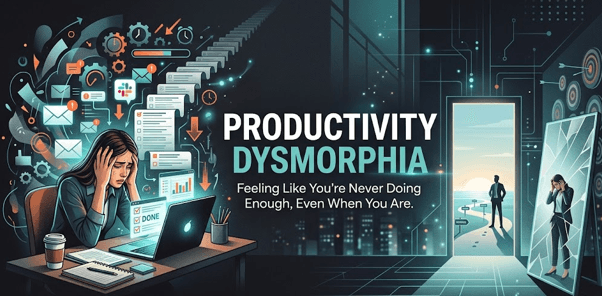
If your achievements feel invisible to you the moment they are completed, you aren’t just ambitious, and you aren’t experiencing standard burnout. You are likely dealing with productivity dysmorphia.
What is Productivity Dysmorphia?
Coined by journalist Anna Codrea-Rado, productivity dysmorphia is the severe disconnect between your objective success and your subjective feeling of output. It is a psychological blind spot where you cannot accurately perceive your own accomplishments.
Think of it as the sibling to body dysmorphia or imposter syndrome, but specifically targeting your labor.
Body Dysmorphia
The brain alters physical perception, making a person see flaws that aren’t there.
Imposter Syndrome
The fear of being exposed as a fraud, despite clear evidence of competence.
Productivity Dysmorphia
The complete inability to internalize your own success, viewing any amount of work as fundamentally insufficient.
When you suffer from this condition, your brain treats your completed work as a baseline of zero. Yesterday’s triumph becomes today’s expected minimum, creating an endless, moving finish line.
The Neurobiology of the Moving Finish Line
To understand why this happens, we have to look at how our brains handle rewards. When we work toward a goal, our brain releases dopamine — the neurotransmitter associated with motivation, anticipation, and pleasure.
However, neuroscientists have found that dopamine levels actually peak during the pursuit of a goal, not upon its completion.
For a healthy brain, this is followed by a sense of satisfaction. But for those trapped in a cycle of overachievement, that sudden neurochemical drop feels like anxiety, emptiness, or failure. To escape that uncomfortable vacuum, the brain immediately demands a new target, shifting the finish line before you’ve even had a chance to catch your breath.
The Three Cultural Traps Fueling the Cycle
This isn’t entirely an individual malfunction. Our modern environment is perfectly engineered to trigger productivity dysmorphia.
The Erasure of Tangible Output
Decades ago, completing work often meant a physical object was built, a file folder was closed, or an assembly line stopped. Today, knowledge work is infinite. When you finish a task, your inbox instantly refills, Slack notifications keep rolling, and your digital workspace looks exactly the same. Without physical markers of completion, the brain struggles to register that an ending has actually occurred.
The Gamification of Labor
Project management tools utilize streaks, progress bars, and glowing green checkmarks. While these keep us engaged, they treat productivity as a video game. The moment a streak ends or a metric resets to zero on Monday morning, we feel a subconscious sense of failure, regardless of how much we achieved the week before.
Optimized Exploitation of the Self
We live in a culture that treats rest as something you must “earn” rather than a biological necessity. We are told to optimize our mornings, monetize our hobbies, and treat our bodies as businesses. When human worth is entirely tethered to output, doing “nothing” feels dangerous.
How to Reset Your Brain’s Perception of Success
Overcoming productivity dysmorphia requires intentionally retraining your brain to see reality. You cannot rely on your feelings to judge your output; you have to rely on objective data.
Keep a “Got-Done” List
To-do lists look forward, emphasizing what you lack. At the end of every day, write a “Got-Done” list. Force yourself to document every small victory, meeting handled, or problem solved. When the anxiety hits, look at the evidence.
Build a “Finished” Buffer
Never jump directly from a massive project into the next one. Create a mandatory 24-to-48-hour buffer zone where you only handle low-stakes administrative tasks, tidy your workspace, or rest. Force your nervous system to register the gap between milestones.
Decouple Identity from Output
Practice regular, non-productive hobbies — things you do solely for the experience, where there is no metric for success, no audience, and no way to optimize the outcome.
Conclusion
Ultimately, productivity dysmorphia thrives on anonymity and speed. By slowing down, documenting your reality, and refusing to immediately run toward the next horizon, you can finally allow yourself to look back at the ground you’ve already conquered.
Your achievements are real. Your effort matters. And you are already enough.